

Finding a good job in the US in 2025–2026 is no easy feat. But is it possible to define the absolute best way to find a job in Manhattan? Actually, that’s exactly what we’ll try to do on manhattan1.one.
Local Job Search Rules: An Introduction
When it comes to Manhattan, the rules of job hunting change dramatically. Many people still Google whether LinkedIn is the only right path and continue blindly sending out hundreds of job applications. But if you’re looking for the best way to find a job in this borough—whether it’s your first serious post-college role or a spot at a top hedge fund—standard algorithms work poorly.
The Manhattan market is truly specific: the juiciest vacancies on Wall Street or in Silicon Alley are snatched up by insiders long before they hit public job boards. So let’s figure out how the inner workings of local hiring actually operate and which steps truly lead to offers.
Manhattan’s Real Numbers: Where the Vacancies Hide

The overall picture in New York might seem quite optimistic—private-sector job numbers have surpassed a record 4.26 million. But if we focus strictly on Manhattan in 2025–2026, we see a much more pragmatic reality. The growth rate of new jobs here has slowed down slightly, hovering around 0.3–1.5%, while the unemployment rate balances between 4.9–5.7%.
What do these numbers mean in practice? There are jobs on the island, and money too, but you will have to compete for every attractive position. The best way to find a job in such conditions is to stop perceiving Manhattan as a single entity. It is a collection of highly specialized business clusters. For your search to make sense, you need to physically and digitally be where your industry is concentrated.
Here is what the distribution of power looks like on the island today:
| Industry | Key Manhattan Location | Hiring Specifics |
|---|---|---|
| Finance (Wall Street) | Financial District, Midtown | Extremely high competition. Most vacancies are closed through private recommendations and internal databases. |
| Tech & Media | Flatiron District (Silicon Alley), Midtown | Constant search for niche specialists. Focus on skills and participation in specialized startup communities. |
| Healthcare | Upper East Side, Washington Heights | Stable demand. Often requires local licensing and ties to the city’s major medical centers. |
| HoReCa Sector | Distributed evenly (with a focus on Soho/Midtown) | High turnover rate, a large percentage of hiring happens through personal visits (walk-ins). |

This geography dictates strict rules. Looking for an analyst position at a hedge fund by sending resumes to companies in Soho is a waste of time. Companies from key neighborhoods rarely hire “people off the street” for important roles. They prefer those who are already integrated into their ecosystem, know the right people, and understand the specifics of a particular neighborhood.
Why LinkedIn Alone Isn’t Enough: The Importance of Diversifying Your Search Channels
Many people looking for their first serious job after college or just moving to New York make the same mistake: they polish their LinkedIn profile, click “Easy Apply” on dozens of vacancies daily, and obediently wait for a miracle. The answer to the popular question of whether this social network is the best and only way to find a job is harsh: it is merely the bare minimum. In Manhattan, about 70–80% of the highest-paying jobs are filled through personal recommendations.
This doesn’t mean that classic nepotism thrives in Manhattan. Rather, it reveals a pattern: in a fiercely fast-paced environment, basic trust carries more weight than a good resume. When five hundred people with equally brilliant diplomas apply for a single role in Midtown, it is easier and safer for a recruiter to invite someone vouched for by a colleague. That is accurately why networking is an effective tool to kickstart a career here.
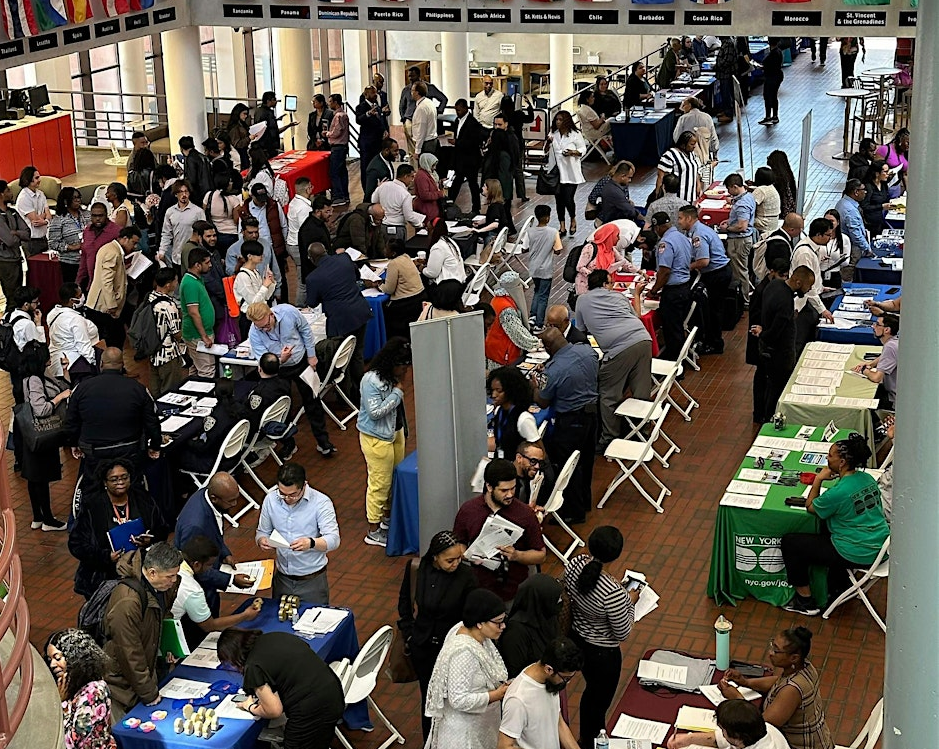
A real driver of this process in one of New York’s wealthiest boroughs is the Manhattan Chamber of Commerce (MCC). This organization operates as a giant super-connector. Instead of waiting weeks for automated rejections from corporate bots, you can attend their Speed Networking events. This allows you to meet dozens of real business owners and recruiters in just an hour. Another powerful MCC tool is the Networking Around Town series, held in various restaurants or coworking spaces. There, in an informal setting, you can strike up a conversation that later turns into an offer.
If you are results-oriented, your Manhattan quota should be 1–3 industry-specific events per week. These could be Industry Mixers, private Business Referral Groups (where 15–40 people gather purely to exchange contacts), or simply meetups in your field. Your main goal is to become a recognizable face in your circle. Because on this island, people are hired much more often not for a perfectly crafted resume, but because the candidate is an interesting, intellectually developed person with whom it was comfortable to discuss market trends over a glass of wine the night before.
Tools and Tactics That Work in Manhattan

While networking opens doors, without a solid digital tactic, they can quickly close. For those looking for the best way to establish themselves in the market after college, the main advice is to narrow your radius. Forget about mindlessly blasting a single template file to all available global platforms. Focus on local resources.
If you’re interested in the tech and innovation sector, make it a habit to monitor Built In NYC and the Tech:NYC community platforms. For those trying to get into the public sector or non-profits, the only reliable path is the city portal NYC.gov Employment or Workforce1 centers. For the hospitality and restaurant industry, NYC Poached is an indispensable assistant. It also never hurts to periodically check the Manhattan Chamber Job Board—a listing from the local chamber of commerce that frequently features exclusive offers from local businesses.
But no matter where you apply, your main weapon is your resume. In Manhattan, it must strictly comply with American corporate standards. This means no photos, age, or personal details, and most importantly—keep it strictly to one page. Employers here buy results, so describe your experience exclusively through numbers and achievements that can be measured in dollars or percentages.
An interesting nuance: while closed meetings decide everything in the financial or IT sectors, the classic walk-in method still works flawlessly in Manhattan’s retail and restaurant industries. A personal visit to an establishment with a printed resume and a confident pitch is often far more effective than a hundred emails.
The final, yet critically important tactic is the art of the follow-up. In a city where time literally equals money, you will be forgotten in a matter of days. If you exchanged contacts with a recruiter or potential employer at an event yesterday, make sure to send them a brief LinkedIn message the very next morning.
A simple thank-you for an interesting conversation cements your image in their memory. Ultimately, finding a job in Manhattan is always a complex game, where the winner is the one who successfully combines active networking, proven search tools, and lightning-fast reactions.